Formation of the MPLA
Another Day of LifeThe Formation of the MPLA is recorded as a concise milestone in the history of Angola’s liberation struggle: on 10 December 1956, the movement arose in Luanda from PLUA and other small liberation groups, with the 34-year-old doctor and poet Agostinho Neto at its head. The book’s later scenes place the organization at the center of a war fought not only for territory but also for political authority and public confidence.
Origins and Leadership
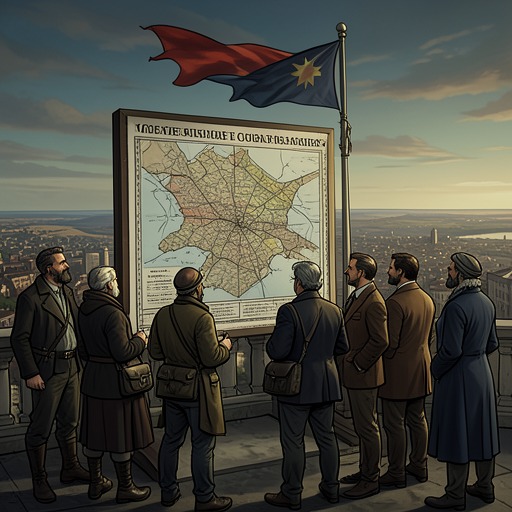
The chronology locates the founding in Luanda and identifies it as the result of a union: PLUA joined with other small liberation groups, and the MPLA emerged from their combination. It gives no account of a founding meeting, negotiations, or internal structure, so the event appears not as a dramatized scene but as a succinct point of political formation.
The same entry names Agostinho Neto as the movement’s leader and identifies him as a doctor and poet, then thirty-four years old. That brief pairing of political leadership, medicine, and poetry is the chronology’s only personal detail about the founding. It establishes who stood at the movement’s head without suggesting that the book provides a fuller account here of how leadership was organized.
The Movement in the War
Later episodes show the MPLA as a force with both military units and political representatives. In the fighting for Caxito, a unit commanded by Comandante Ndozi seized the town from the FNLA. The MPLA political commissar Comandante Ju-Ju announced developments in daily radio communiqués; after the capture, he questioned 120 FNLA prisoners. These scenes give the movement a presence on the battlefield and in the work of explaining, interpreting, and contesting the war.
That public account of the conflict was not always reassuring. The narrator observes that Ju-Ju’s communiqués were brief when events were going well but grew longer and more emphatic when the situation deteriorated. In November, the contrast between the optimistic broadcasts and the narrator’s sense that half the country was in enemy hands threatened to weaken confidence rather than restore it. The movement’s communications thus appear as part of the struggle to sustain action under pressure, while remaining vulnerable to the distance between official assurances and events on the ground.
Luanda, Authority, and Independence
The MPLA’s wartime role unfolded amid the disintegration of ordinary authority in Luanda. Portuguese residents fled toward the airport and waited in makeshift encampments; the police departed, and the city’s garbage collectors followed. In one hotel raid, armed men threatened guests and sought a list of residents, but the MPLA press chief Almeyda arrived in the morning and ordered them to release the group and leave. The episode shows an MPLA official intervening where routine policing had failed, without making that single intervention a substitute for the broader breakdown around it.
The movement also faced hostile messaging. Leaflets dropped over Luanda claimed that Holden Roberto’s army would soon enter the capital and urged the population to kill Eastern European personnel said to command MPLA units. The narrator records that he was the only person from Eastern Europe in all Angola at the time. Later, as Holden announced an imminent entry into Luanda, further leaflets promoted his authority while artillery fire and panic unsettled the city. These episodes place the MPLA within a contest over the city’s future and over which claims people would trust.
On 11 November 1975, Agostinho Neto proclaimed the People’s Republic of Angola in Luanda. The book records the declaration amid exhaustion, darkness, and celebratory gunfire rather than as a simple resolution of the preceding uncertainty. Read alongside the founding entry, the later scenes trace the MPLA’s passage from a coalition of liberation groups to a movement centrally involved in the military and political struggle surrounding independence, while leaving the human and institutional disorder of that moment plainly visible.